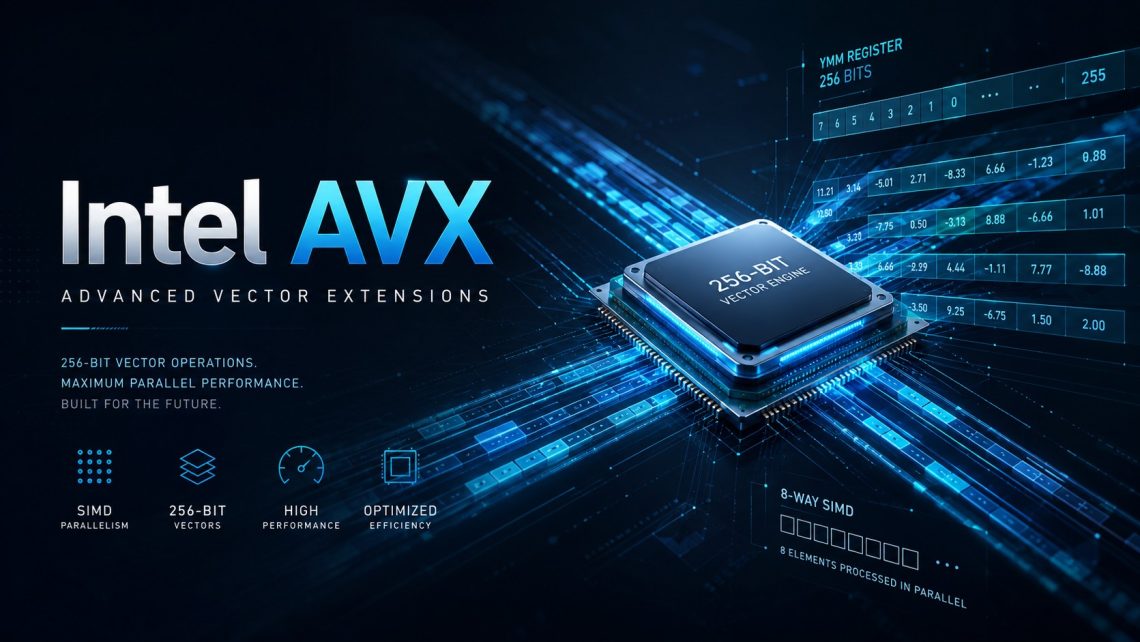
Intel AVX, short for Advanced Vector Extensions, marked one of the most important transitions in the history of x86 SIMD programming. It extended the 128-bit SSE model to 256-bit vector registers, introduced a cleaner instruction encoding, and made SIMD code easier for compilers and developers to optimize.
AVX was first introduced on Intel processors with the Sandy Bridge microarchitecture. In practical terms, it allowed a single CPU instruction to operate on more floating-point values at once: eight 32-bit floating-point values or four 64-bit double-precision values in a 256-bit YMM register.
This made AVX especially important for workloads such as scientific computing, image processing, video processing, audio DSP, physics engines, financial simulations, and any code that performs the same arithmetic operation over large arrays of data.
In this article, “AVX” refers mainly to the original Intel AVX instruction set, sometimes called AVX1, with comparisons to SSE, AVX2, FMA, AVX-512, and newer AVX-family extensions where useful.
Why AVX mattered
Before AVX, the SSE family had already made SIMD programming mainstream on x86 processors. SSE and SSE2 introduced 128-bit vector registers and made it possible to process multiple values in parallel. Later extensions such as SSE3, SSSE3, SSE4.1, and SSE4.2 added better shuffling, text processing, dot products, blends, and other useful operations.
AVX changed the model in three major ways:
- It doubled the floating-point SIMD register width from 128 bits to 256 bits.
- It introduced the YMM register file, extending the existing XMM registers.
- It introduced VEX encoding, which enabled a cleaner three-operand instruction format.
The first point is the most visible one, but the third point is just as important. VEX encoding made many instructions easier to schedule because the destination register no longer had to overwrite one of the input registers.
With SSE, many instructions used a destructive two-operand form:
addps xmm0, xmm1 ; xmm0 = xmm0 + xmm1
With AVX, the same kind of operation can use a non-destructive three-operand form:
vaddps ymm0, ymm1, ymm2 ; ymm0 = ymm1 + ymm2
This means the result can be written to a separate register while both source operands remain unchanged. That reduces the need for extra move instructions and gives the compiler more freedom when allocating registers.
SIMD in one sentence
SIMD means “single instruction, multiple data”. Instead of adding one number at a time, the CPU applies the same operation to several values packed inside a vector register.
For example, a scalar floating-point addition processes one value:
c0 = a0 + b0
A 256-bit AVX addition can process eight single-precision values:
c0 = a0 + b0
c1 = a1 + b1
c2 = a2 + b2
c3 = a3 + b3
c4 = a4 + b4
c5 = a5 + b5
c6 = a6 + b6
c7 = a7 + b7
All of this is represented by one vector instruction.
The CPU is not doing less work magically. Instead, it is using wider execution units and wider registers to express more independent operations per instruction. When the data layout and memory bandwidth cooperate, this can produce a large speedup.
How AVX compares with earlier SIMD instruction sets
| Instruction set | Register width | Main focus | Key contribution |
|---|---|---|---|
| MMX | 64-bit | Packed integers | Early SIMD for multimedia and integer data |
| SSE | 128-bit | Single-precision floating point | Introduced XMM registers |
| SSE2 | 128-bit | Double-precision floating point and integer SIMD | Made SIMD broadly useful on x86 |
| SSE3 | 128-bit | Horizontal arithmetic and data movement | Added selected complex-number and reduction-friendly operations |
| SSSE3 | 128-bit | Shuffles and byte manipulation | Added powerful byte-level rearrangement instructions |
| SSE4.1 | 128-bit | Blends, dot products, integer operations | Improved media and general-purpose SIMD |
| SSE4.2 | 128-bit | Text and string processing | Added CRC and string comparison instructions |
| AVX | 256-bit for floating point | Wider floating-point SIMD | Introduced YMM registers and VEX encoding |
| FMA | 128-bit and 256-bit | Fused multiply-add | Computes a * b + c with one rounding step |
| AVX2 | 256-bit | Integer SIMD and gather support | Extended most integer SIMD operations to 256 bits |
| AVX-512 | 512-bit | Wider vectors, masks, more registers | Added ZMM registers, opmask registers, and many specialized extensions |
The important nuance is that original AVX did not simply make every SSE operation twice as wide. Its headline improvement was 256-bit floating-point SIMD. Full 256-bit integer SIMD arrived later with AVX2.
The AVX register model
AVX introduced 256-bit YMM registers.
The lower 128 bits of each YMM register overlap with the older XMM register. Conceptually:
YMM0 = upper 128 bits + XMM0
YMM1 = upper 128 bits + XMM1
YMM2 = upper 128 bits + XMM2
...
In 64-bit mode, x86-64 provides sixteen architectural XMM/YMM registers: xmm0 to xmm15, extended as ymm0 to ymm15.
A 256-bit YMM register can hold:
| Data type | Elements per YMM register |
|---|---|
| 32-bit float | 8 |
| 64-bit double | 4 |
| 32-bit integer | 8, but full 256-bit integer arithmetic is mainly AVX2 |
| 64-bit integer | 4, but full 256-bit integer arithmetic is mainly AVX2 |
For original AVX, the most important packed types are single-precision and double-precision floating-point values.
VEX encoding and three-operand instructions
One of the less visible but very important changes in AVX is VEX encoding.
Legacy SSE instructions usually have two operands, where one operand is both input and output:
mulps xmm0, xmm1 ; xmm0 = xmm0 * xmm1
AVX instructions can use three operands:
vmulps ymm0, ymm1, ymm2 ; ymm0 = ymm1 * ymm2
This has several benefits:
- The destination register can be different from both source registers.
- The compiler often needs fewer register-to-register moves.
- Instruction scheduling can be cleaner.
- The same encoding model supports both 128-bit and 256-bit forms.
- Many 128-bit SSE-like operations can be encoded in AVX form.
This is why AVX is useful even when using 128-bit vectors. The VEX-encoded 128-bit instruction form can still provide cleaner register behavior than older SSE encodings.
What AVX added
Original AVX added a broad set of floating-point vector operations and supporting instructions.
The most important categories include:
| Category | Examples |
|---|---|
| Arithmetic | Add, subtract, multiply, divide, square root |
| Comparisons | Packed floating-point comparisons with richer predicate options |
| Data movement | 128-bit and 256-bit loads and stores |
| Broadcasts | Load one value and replicate it across a vector |
| Permutes | Rearrange elements inside vectors |
| Blends | Select elements from two vectors |
| Tests | Vector test instructions for masks and flags |
| State management | Instructions such as vzeroupper and vzeroall |
AVX is especially strong when the computation is naturally expressed as operations over arrays of float or double.
Typical examples include:
- Adding two arrays
- Multiplying two arrays
- Scaling a vector
- Computing dot products
- Matrix operations
- Pixel transformations
- Audio sample processing
- Physics and simulation loops
What AVX did not add
A common misunderstanding is that AVX means “all SIMD operations are now 256-bit”. That is not true for original AVX.
Original AVX mainly widened floating-point SIMD operations. It did not provide a complete 256-bit integer SIMD instruction set. That came with AVX2.
Another common misunderstanding is to treat FMA as part of base AVX. FMA uses the AVX register model and VEX encoding, but it is a separate instruction set extension. Early Sandy Bridge processors supported AVX but did not support FMA. FMA became widely associated with later Intel processors such as Haswell.
So the practical distinction is:
| Feature | Extension |
|---|---|
| 256-bit floating-point vectors | AVX |
| Fused multiply-add | FMA |
| 256-bit integer SIMD | AVX2 |
| 256-bit gather operations | AVX2 |
| 512-bit vectors and mask registers | AVX-512 |
Example: adding arrays with AVX intrinsics
The following C example adds two arrays of single-precision floating-point values using AVX intrinsics.
#include <immintrin.h>
#include <stddef.h>

void add_float_avx(const float *a, const float *b, float *out, size_t count)
{
    size_t i = 0;

    for (; i + 8 <= count; i += 8)
    {
        __m256 va = _mm256_loadu_ps(a + i);
        __m256 vb = _mm256_loadu_ps(b + i);
        __m256 vc = _mm256_add_ps(va, vb);

        _mm256_storeu_ps(out + i, vc);
    }

    for (; i < count; ++i)
    {
        out[i] = a[i] + b[i];
    }
}
The loop processes eight float values per iteration:
a[i + 0] ... a[i + 7]
b[i + 0] ... b[i + 7]
The intrinsic _mm256_add_ps maps naturally to a packed single-precision AVX addition.
The scalar loop at the end handles the remaining elements when the array size is not a multiple of eight.
Compile flags
For GCC or Clang, compile AVX code with:
gcc -O3 -mavx source.c -o program
or:
clang -O3 -mavx source.c -o program
For Microsoft Visual C++, use:
/arch:AVX
The usual header for AVX intrinsics is:
#include <immintrin.h>
Be careful when enabling AVX globally. A binary compiled with AVX instructions will not run on a CPU or operating system that does not support AVX state management. For portable applications, keep a baseline scalar or SSE path and dispatch to the AVX path only after runtime feature detection.
Runtime detection
Detecting AVX is more complex than detecting older SSE extensions.
It is not enough to check whether the CPU advertises AVX. The operating system must also support saving and restoring the extended YMM register state during context switches.
A robust AVX check normally verifies:
- The CPU supports AVX.
- The CPU supports XSAVE.
- The operating system has enabled XSAVE support.
- The XMM and YMM state bits are enabled in
XCR0.
In CPUID terms, AVX support is associated with CPUID leaf 1 feature bits, and operating-system support is checked with OSXSAVE and XGETBV.
In application code, this is usually handled by:
- Compiler built-ins
- Runtime dispatch libraries
- CPU feature detection modules
- Platform-specific APIs
- Existing libraries such as oneAPI, OpenBLAS, FFT libraries, image processing libraries, or game engines
The key point is simple: do not execute AVX instructions merely because the CPU name looks modern. Check the feature flags properly.
AVX and memory bandwidth
AVX can double the amount of floating-point data processed per instruction compared with 128-bit SSE, but this does not automatically double program performance.
The speedup depends on the bottleneck.
If the loop is compute-bound, AVX can help significantly. If the loop is memory-bandwidth-bound, wider vectors may not improve performance much because the CPU is already waiting for data from cache or memory.
For example, this operation is often limited by memory bandwidth:
out[i] = a[i] + b[i]
For each element, it loads two floats and stores one float. The arithmetic is cheap; the memory traffic is the limiting factor.
By contrast, a loop that performs many arithmetic operations per loaded value has a better chance of benefiting from AVX.
Examples include:
- Matrix multiplication
- Polynomial evaluation
- DSP filters
- Physics kernels
- Complex-number arithmetic
- Some image convolution filters
- Scientific simulation inner loops
The best AVX code usually improves both computation and memory behavior. It uses vector instructions, but it also pays attention to cache locality, alignment, loop structure, and data layout.
Data layout matters
SIMD works best when data is contiguous and homogeneous.
An array of structures can be inconvenient:
typedef struct Pixel
{
    float r;
    float g;
    float b;
    float a;
} Pixel;

Pixel pixels[count];
This layout is often natural for application code, but SIMD code may prefer separate arrays:
float r[count];
float g[count];
float b[count];
float a[count];
This is called structure of arrays, or SoA. It allows AVX to load eight red values, eight green values, eight blue values, or eight alpha values with simple contiguous loads.
The best layout depends on the workload. For rendering, image processing, physics, and data analytics, layout decisions can matter as much as the instruction set itself.
Alignment and unaligned loads
AVX supports both aligned and unaligned memory accesses.
Common intrinsics include:
_mm256_load_ps      // aligned load
_mm256_loadu_ps     // unaligned load
_mm256_store_ps     // aligned store
_mm256_storeu_ps    // unaligned store
Modern x86 processors handle many unaligned loads efficiently, especially when the access does not cross cache-line or page boundaries. Still, alignment remains useful in hot loops because it can reduce edge cases and make memory behavior more predictable.
A good practical rule is:
- Use aligned allocation when convenient.
- Use unaligned loads when the pointer alignment is unknown.
- Avoid complicated code unless profiling proves alignment is a bottleneck.
Correctness is more important than forcing aligned loads everywhere.
Horizontal operations and reductions
AVX is excellent at vertical SIMD operations, where each element is processed independently:
c[i] = a[i] + b[i]
Reductions are more complicated:
sum = a[0] + a[1] + a[2] + ...
A reduction eventually needs to combine values inside a vector. This requires horizontal operations, shuffles, or extraction of lanes.
For AVX, one common strategy is:
- Accumulate several independent
__m256partial sums. - Reduce each vector at the end.
- Combine the final scalar results.
This avoids doing horizontal reductions too often inside the main loop.
A simplified example:
#include <immintrin.h>
#include <stddef.h>

float sum_float_avx(const float *a, size_t count)
{
    size_t i = 0;
    __m256 acc = _mm256_setzero_ps();

    for (; i + 8 <= count; i += 8)
    {
        __m256 v = _mm256_loadu_ps(a + i);
        acc = _mm256_add_ps(acc, v);
    }

    float temp[8];
    _mm256_storeu_ps(temp, acc);

    float sum =
        temp[0] + temp[1] + temp[2] + temp[3] +
        temp[4] + temp[5] + temp[6] + temp[7];

    for (; i < count; ++i)
    {
        sum += a[i];
    }

    return sum;
}
This is not the most optimized reduction possible, but it shows the basic pattern: vectorize the main loop, then handle the horizontal reduction at the end.
Avoiding SSE and AVX transition penalties
On some Intel processors, mixing legacy SSE instructions and AVX instructions can cause performance penalties. The issue appears when AVX code uses the upper half of YMM registers and then the program transitions to legacy SSE code that is unaware of that upper state.
The usual fix is to execute:
vzeroupper
before returning from AVX code to code that may use legacy SSE instructions.
Compilers normally insert vzeroupper where needed when compiling AVX functions, but this is still important to understand when writing assembly, using separate object files, or mixing different compiler flags.
A practical approach is:
- Compile related SIMD code consistently.
- Prefer VEX-encoded instructions when using AVX.
- Let the compiler insert
vzeroupperunless you are writing hand-tuned assembly. - Be careful at function boundaries between AVX and non-AVX code.
AVX and CPU frequency
Wide vector instructions can increase power consumption. On many processors, heavy AVX, AVX2, or AVX-512 workloads may run at different frequencies than scalar code.
The effect depends heavily on the processor generation, the instruction mix, the thermal budget, and whether the workload is using 256-bit or 512-bit operations.
For original AVX, this is usually less dramatic than with AVX-512, but it is still worth measuring. On laptops and small-form-factor systems, thermal limits can dominate long-running performance.
The rule is simple: benchmark on the target hardware.
Do not assume that wider vectors are always faster. They often are, but real performance depends on the entire system.
AVX, AVX2, FMA, and AVX-512
AVX became the foundation for several later x86 SIMD extensions.
AVX
Original AVX introduced 256-bit YMM registers, VEX encoding, and 256-bit floating-point SIMD.
Best fit:
- Floating-point arrays
- Scientific code
- Image and signal processing
- Code that was already SSE-friendly and can benefit from wider vectors
FMA
FMA adds fused multiply-add operations such as:
a * b + c
The “fused” part means the multiplication and addition are performed with a single final rounding step. This improves both performance and numerical behavior for many workloads.
FMA is especially useful for:
- Matrix multiplication
- Dot products
- Polynomial evaluation
- DSP
- Physics
- Machine learning kernels
AVX2
AVX2 extends the 256-bit model to many integer operations. It also adds gather instructions and other useful operations.
Best fit:
- Integer-heavy SIMD
- Image processing
- Compression
- Hashing
- Text and byte processing
- Data transformations
AVX-512
AVX-512 expands the model to 512-bit ZMM registers and adds mask registers. It also introduces many specialized extensions for specific workloads.
Best fit:
- HPC
- Scientific computing
- AI and deep learning primitives
- Cryptography
- High-throughput server workloads
- Specialized vector kernels
AVX-512 is powerful, but it is also more fragmented across processor generations than AVX and AVX2. Code that uses AVX-512 must be careful about feature detection and target CPU support.
When to use AVX intrinsics
AVX intrinsics are useful when:
- The compiler cannot auto-vectorize a critical loop.
- You need predictable SIMD code generation.
- The data layout is known and stable.
- Profiling shows the loop is worth optimizing.
- You can maintain separate scalar and AVX code paths.
- The operation maps cleanly to AVX instructions.
AVX intrinsics are not always the first tool to use. Modern compilers are often good at auto-vectorizing simple loops when optimization is enabled. Before writing intrinsics, try:
for (size_t i = 0; i < count; ++i)
{
    out[i] = a[i] + b[i];
}
with aggressive optimization flags and inspect the generated assembly. The compiler may already generate AVX code.
Use intrinsics when the compiler needs help or when you need explicit control.
Common pitfalls
Assuming AVX always doubles performance
AVX doubles vector width compared with SSE for floating-point operations, but that does not guarantee a 2x speedup. Memory bandwidth, cache misses, dependencies, branches, and instruction throughput can all limit performance.
Using AVX without runtime dispatch
If the binary runs on older CPUs, do not compile the entire program with AVX and assume it will work everywhere. Use runtime dispatch or separate builds.
Forgetting operating-system support
AVX requires operating-system support for saving and restoring YMM state. CPU support alone is not sufficient.
Mixing legacy SSE and AVX carelessly
Transitions between AVX and old SSE code can hurt performance on some processors. Use compiler-generated boundaries or vzeroupper when appropriate.
Using poor data layout
SIMD needs data that can be loaded efficiently. If data is scattered, interleaved awkwardly, or branch-heavy, AVX may not help much.
Reducing too often
Horizontal reductions inside the main loop can destroy throughput. Accumulate in vectors and reduce at the end when possible.
Overusing intrinsics too early
Intrinsics make code harder to read and maintain. Start with clear scalar code, enable compiler vectorization, profile, and then optimize the real bottlenecks.
Practical optimization checklist
When optimizing with AVX, use this checklist:
- Profile first.
- Confirm the loop is actually hot.
- Check whether the compiler already auto-vectorizes it.
- Make data contiguous where possible.
- Prefer simple loop bounds and predictable memory access.
- Process eight floats or four doubles per AVX vector.
- Handle the scalar tail correctly.
- Avoid unnecessary horizontal operations in the inner loop.
- Use runtime feature detection for portable binaries.
- Benchmark on the real target CPU.
Example workloads where AVX shines
AVX is especially effective in workloads with regular floating-point computation.
Good examples include:
- Vector addition and scaling
- Dot products
- Matrix-vector multiplication
- Matrix multiplication kernels
- FFT preprocessing
- Audio filters
- Image color conversion
- Image convolution
- Physics simulation
- Particle systems
- Numerical solvers
- Financial Monte Carlo simulations
AVX is less effective when the workload is dominated by:
- Random memory access
- Pointer chasing
- Small arrays
- Branch-heavy logic
- Serialization
- I/O
- Data structures that do not vectorize cleanly
The best AVX workloads are predictable, dense, arithmetic-heavy, and cache-friendly.
AVX in modern software
AVX is now a baseline expectation for many performance-sensitive x86 software stacks, but it is not always the minimum requirement for general-purpose applications.
Many libraries provide multiple optimized code paths:
Scalar baseline
SSE2 path
SSE4.1 path
AVX path
AVX2 + FMA path
AVX-512 path
At runtime, the library selects the best supported path for the current CPU.
This model is common in:
- BLAS libraries
- Media codecs
- Compression libraries
- Cryptographic libraries
- Game engines
- Image processing frameworks
- Machine learning runtimes
For application developers, this means AVX is often used indirectly through optimized libraries. You may benefit from AVX even without writing AVX intrinsics yourself.
Conclusion
Intel AVX was more than a simple widening of SSE. It introduced a cleaner SIMD programming model with 256-bit YMM registers and VEX-encoded three-operand instructions. It gave x86 processors a stronger foundation for floating-point vector computation and became the base for later extensions such as FMA, AVX2, AVX-512, and AVX10.
Its main strength is straightforward: process more floating-point data per instruction.
Its main limitation is equally important: wider vectors help only when the workload, memory layout, compiler, and CPU microarchitecture allow them to help.
For developers, AVX remains a valuable tool. It is especially useful in performance-critical loops over arrays of floats or doubles, where the same operation is repeated over large amounts of data. Used carefully, it can turn ordinary scalar code into a much more efficient parallel data pipeline running directly inside the CPU core.
References
- Intel® 64 and IA-32 Architectures Software Developer’s Manuals
- Intel® Intrinsics Guide
- Introduction to Intel® Advanced Vector Extensions, Chris Lomont
- GCC x86 options
- Microsoft Learn: Using extended processor features in Windows drivers
- Intel® AVX-512 instructions
- Agner Fog optimization manuals and instruction tables