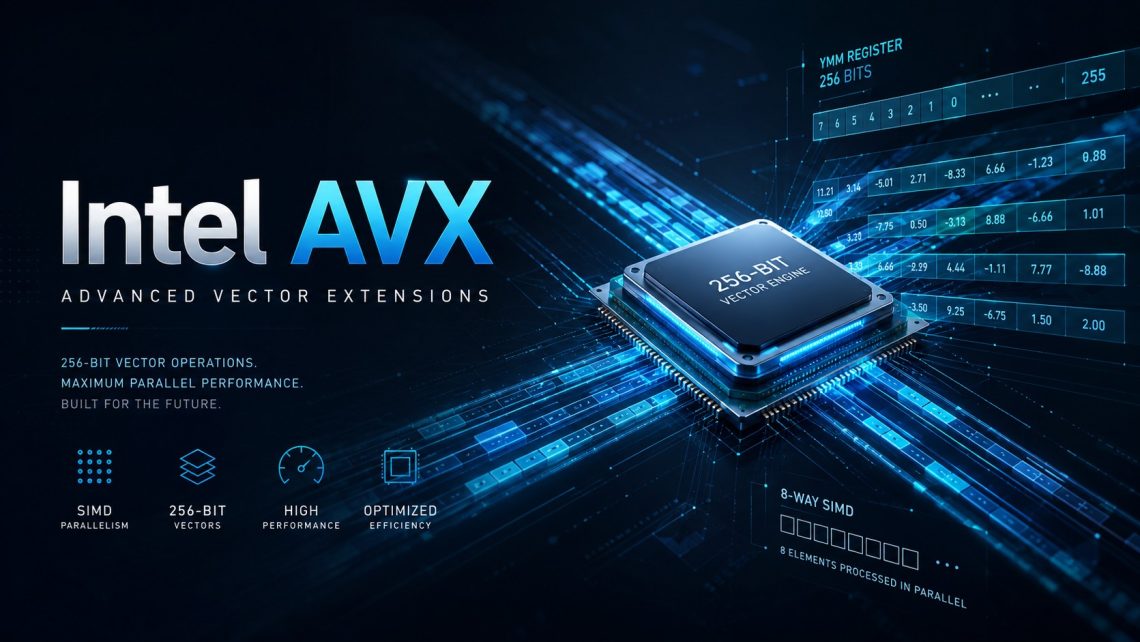
Intel AVX2 is one of the most important SIMD extensions in the x86 instruction set. While the original AVX instruction set introduced 256-bit YMM registers and wider floating-point vector operations, AVX2 extended that model to integer SIMD and made 256-bit vector programming much more broadly useful.
AVX2 arrived with Intel’s Haswell microarchitecture and is sometimes referred to as part of the “Haswell New Instructions” generation. Its main contribution was simple but powerful: many integer SIMD operations that previously worked on 128-bit XMM registers could now operate on 256-bit YMM registers.
This mattered because not all performance-critical code is floating-point code. Image processing, video codecs, compression, cryptography, text processing, hashing, database scanning, packet processing, and many data transformation workloads are heavily integer-based. AVX2 brought these workloads into the 256-bit SIMD era.
In this article, “AVX2” refers to Intel Advanced Vector Extensions 2, with comparisons to MMX, SSE, SSE2, SSSE3, SSE4.1, SSE4.2, AVX, FMA, AVX-512, and newer AVX-family extensions where useful.
Why AVX2 mattered
Original AVX was a major step forward, but it was mostly focused on floating-point SIMD. It introduced the 256-bit YMM register model and VEX-encoded instructions, but most 256-bit integer SIMD operations were still missing.
AVX2 filled that gap.
With AVX2, developers could use 256-bit vectors for packed integer operations such as:
- 32 byte operations at once
- 16 16-bit integer operations at once
- 8 32-bit integer operations at once
- 4 64-bit integer operations at once
This made AVX2 much more useful for general-purpose high-performance code than AVX alone.
The big changes were:
- Most 128-bit integer SIMD operations were promoted to 256-bit YMM registers.
- New integer vector instructions were added.
- Gather instructions were introduced.
- More powerful permutes, broadcasts, blends, and shifts became available.
- The AVX/VEX programming model became useful for both floating-point and integer-heavy workloads.
In practice, AVX2 became the instruction set that many developers think of when they think of “modern x86 SIMD”.
SIMD in one sentence
SIMD means “single instruction, multiple data”. A single instruction performs the same operation on multiple values packed inside one vector register.
For example, scalar integer addition processes one pair of integers:
c0 = a0 + b0
A 256-bit AVX2 integer addition can process eight 32-bit integers:
c0 = a0 + b0
c1 = a1 + b1
c2 = a2 + b2
c3 = a3 + b3
c4 = a4 + b4
c5 = a5 + b5
c6 = a6 + b6
c7 = a7 + b7
All of that can be represented by one vector instruction.
For byte-oriented work, AVX2 can operate on 32 packed 8-bit values in a single 256-bit register. This is one of the reasons AVX2 is so useful for image processing, masks, classification, lookup-like transformations, and data parsing.
How AVX2 compares with earlier SIMD instruction sets
| Instruction set | Register width | Main focus | Key contribution |
|---|---|---|---|
| MMX | 64-bit | Packed integers | Early SIMD for multimedia and integer data |
| SSE | 128-bit | Single-precision floating point | Introduced XMM registers |
| SSE2 | 128-bit | Double-precision floating point and integer SIMD | Made SIMD broadly useful on x86 |
| SSE3 | 128-bit | Horizontal arithmetic and data movement | Added selected reduction-friendly operations |
| SSSE3 | 128-bit | Shuffles and byte manipulation | Added powerful byte-level rearrangement instructions |
| SSE4.1 | 128-bit | Blends, dot products, integer operations | Improved media and general-purpose SIMD |
| SSE4.2 | 128-bit | Text and string processing | Added CRC and string comparison instructions |
| AVX | 256-bit for floating point | Wider floating-point SIMD | Introduced YMM registers and VEX encoding |
| AVX2 | 256-bit | Integer SIMD, gather, richer permutes | Brought most integer SIMD operations to 256 bits |
| FMA | 128-bit and 256-bit | Fused multiply-add | Computes a * b + c with one rounding step |
| AVX-512 | 512-bit | Wider vectors, masks, more registers | Added ZMM registers, mask registers, and specialized extensions |
The important distinction is that AVX and AVX2 are not the same thing.
AVX introduced the 256-bit vector model mainly for floating-point operations. AVX2 extended that model to integer SIMD.
AVX2 and the YMM register model
AVX2 uses the same 256-bit YMM registers introduced by AVX.
Each YMM register extends the corresponding 128-bit XMM register:
YMM0 = upper 128 bits + XMM0
YMM1 = upper 128 bits + XMM1
YMM2 = upper 128 bits + XMM2
...
In 64-bit mode, x86-64 provides sixteen architectural XMM/YMM registers:
xmm0  to xmm15
ymm0  to ymm15
A 256-bit YMM register can hold:
| Data type | Elements per YMM register |
|---|---|
| 8-bit integer | 32 |
| 16-bit integer | 16 |
| 32-bit integer | 8 |
| 64-bit integer | 4 |
| 32-bit float | 8 |
| 64-bit double | 4 |
With AVX2, the integer rows in this table become much more important. The register is no longer mainly a wider floating-point container. It becomes a general 256-bit SIMD register for many integer and floating-point workloads.
What AVX2 added
AVX2 added a broad set of integer and data movement instructions.
The most important categories include:
| Category | Examples |
|---|---|
| 256-bit integer arithmetic | Add, subtract, multiply variants |
| 256-bit integer comparisons | Equality and greater-than comparisons for packed integers |
| Boolean operations | And, or, xor, and-not over integer vectors |
| Shifts | Fixed and variable shifts on packed integer elements |
| Permutes | Reorder 32-bit and 64-bit elements |
| Broadcasts | Replicate scalar or smaller vector values across a YMM register |
| Gather loads | Load elements from non-contiguous memory addresses |
| Blends | Select elements from two vectors |
| Vector inserts and extracts | Move 128-bit lanes into and out of 256-bit vectors |
The headline change is that many familiar integer operations from SSE2, SSSE3, and SSE4.1 gained 256-bit versions.
For example:
__m256i _mm256_add_epi8(__m256i a, __m256i b);
__m256i _mm256_add_epi16(__m256i a, __m256i b);
__m256i _mm256_add_epi32(__m256i a, __m256i b);
__m256i _mm256_add_epi64(__m256i a, __m256i b);
These intrinsics operate on packed integers inside 256-bit vectors.
AVX2 versus AVX
The simplest way to understand AVX2 is this:
AVX  = 256-bit floating-point SIMD
AVX2 = 256-bit integer SIMD plus new data movement features
That is not a complete definition, but it captures the practical difference.
Original AVX already had 256-bit floating-point operations such as:
_mm256_add_ps
_mm256_mul_ps
_mm256_add_pd
_mm256_mul_pd
AVX2 added 256-bit integer operations such as:
_mm256_add_epi32
_mm256_sub_epi16
_mm256_mullo_epi32
_mm256_cmpeq_epi8
_mm256_and_si256
_mm256_or_si256
_mm256_slli_epi32
AVX2 also added more powerful data rearrangement operations, which are often just as important as arithmetic operations in real SIMD code.
VEX encoding and three-operand instructions
Like AVX, AVX2 uses VEX encoding.
Legacy SSE instructions often use destructive two-operand forms:
paddd xmm0, xmm1 ; xmm0 = xmm0 + xmm1
AVX2 instructions can use three operands:
vpaddd ymm0, ymm1, ymm2 ; ymm0 = ymm1 + ymm2
This is a major improvement for compiler-generated code and hand-written assembly.
The destination register can be different from both source registers, which reduces unnecessary moves and makes register allocation easier.
For example, with AVX2:
vpaddd ymm3, ymm1, ymm2
The CPU computes:
ymm3 = ymm1 + ymm2
while preserving both ymm1 and ymm2.
This model is cleaner than the older SSE style and is one of the reasons VEX-encoded SIMD became the foundation for later x86 vector extensions.
Example: adding 32-bit integer arrays with AVX2
The following C example adds two arrays of 32-bit integers using AVX2 intrinsics.
#include <immintrin.h>
#include <stddef.h>
#include <stdint.h>

void add_int32_avx2(const int32_t *a, const int32_t *b, int32_t *out, size_t count)
{
    size_t i = 0;

    for (; i + 8 <= count; i += 8)
    {
        __m256i va = _mm256_loadu_si256((const __m256i *)(a + i));
        __m256i vb = _mm256_loadu_si256((const __m256i *)(b + i));
        __m256i vc = _mm256_add_epi32(va, vb);

        _mm256_storeu_si256((__m256i *)(out + i), vc);
    }

    for (; i < count; ++i)
    {
        out[i] = a[i] + b[i];
    }
}
The AVX2 loop processes eight int32_t values per iteration:
a[i + 0] ... a[i + 7]
b[i + 0] ... b[i + 7]
The intrinsic _mm256_add_epi32 performs eight packed 32-bit integer additions.
The scalar loop at the end handles the remaining elements when the array length is not a multiple of eight.
Example: comparing bytes with AVX2
AVX2 is especially useful for byte-oriented workloads because a 256-bit register can hold 32 bytes.
The following example compares 32 bytes against a target byte value:
#include <immintrin.h>
#include <stdint.h>

uint32_t compare_32_bytes_avx2(const uint8_t *data, uint8_t value)
{
    __m256i bytes = _mm256_loadu_si256((const __m256i *)data);
    __m256i target = _mm256_set1_epi8((char)value);
    __m256i cmp = _mm256_cmpeq_epi8(bytes, target);

    return (uint32_t)_mm256_movemask_epi8(cmp);
}
This function returns a 32-bit mask. Each bit corresponds to one byte comparison.
If bit n is set, then:
data[n] == value
This pattern is common in:
- Text scanning
- Parsers
- Tokenizers
- Search routines
- Compression codecs
- Binary format validation
- Image masks
- Byte classification
The combination of _mm256_cmpeq_epi8 and _mm256_movemask_epi8 is one of the classic AVX2 idioms for high-speed byte processing.
Gather instructions
AVX2 introduced gather instructions.
A normal vector load reads contiguous memory:
load a[i + 0], a[i + 1], a[i + 2], ... a[i + 7]
A gather load reads from different addresses selected by an index vector:
load a[index0], a[index1], a[index2], ... a[index7]
For example:
#include <immintrin.h>
#include <stdint.h>

__m256i gather_int32_avx2(const int32_t *base, __m256i indices)
{
    return _mm256_i32gather_epi32(base, indices, 4);
}
The scale argument is usually 1, 2, 4, or 8, depending on the size of the indexed elements. For int32_t, a scale of 4 is typical.
Gather is useful when data is not stored contiguously, such as:
- Sparse data structures
- Table lookups
- Indirect indexing
- Some image processing kernels
- Geometry processing
- Database queries
- Scientific workloads with irregular access patterns
However, gather is not magic. It is usually slower than a regular contiguous load. If you can arrange your data to be contiguous, that is often better than relying on gather.
A good rule is:
Contiguous loads are preferred.
Gather is useful when irregular access is unavoidable.
AVX2 lane behavior
One important detail is that many AVX2 operations behave as two independent 128-bit lanes inside the 256-bit register.
Conceptually:
YMM register = lower 128-bit lane + upper 128-bit lane
Some operations do not freely move data across the full 256-bit register. They operate independently within each 128-bit half.
This matters for shuffles, unpacking, horizontal operations, and some permutations.
For example, a byte shuffle may operate separately on the lower and upper 128-bit lanes. If you need data to cross the lane boundary, you may need a different permute instruction or an extra lane-crossing operation.
This is one of the most common surprises when moving from SSE to AVX2. The vector is 256 bits wide, but not every operation treats it as one fully flexible 256-bit object.
Permutes, shuffles, and data rearrangement
SIMD performance is not only about arithmetic. Real workloads often spend a lot of effort moving data into the right shape.
AVX2 added important data rearrangement capabilities, including:
- Permuting 32-bit elements
- Permuting 64-bit elements
- Broadcasting scalar values
- Inserting and extracting 128-bit lanes
- Blending values from two vectors
- Variable shifts
This is especially important for:
- Image channel conversion
- Pixel packing and unpacking
- Compression
- Cryptography
- Text processing
- Matrix transposition
- Audio sample format conversion
- Data layout transformation
In many AVX2 kernels, the arithmetic is easy. The hard part is arranging the data efficiently enough that the arithmetic units stay busy.
AVX2 and FMA
AVX2 and FMA are often discussed together because Intel introduced both in the Haswell generation.
However, they are separate instruction set extensions.
AVX2 provides 256-bit integer SIMD and related data movement features. FMA provides fused multiply-add instructions, such as:
a * b + c
A fused multiply-add performs the multiply and add as one operation with a single final rounding step.
FMA is mostly associated with floating-point workloads:
- Matrix multiplication
- Dot products
- Polynomial evaluation
- DSP filters
- Physics simulation
- Machine learning kernels
AVX2 is especially important for integer workloads:
- Image processing
- Video codecs
- Compression
- Hashing
- Text scanning
- Byte classification
- Database filtering
In practice, many optimized libraries use both AVX2 and FMA when available. But for feature detection and compiler flags, they should be treated as separate capabilities.
Compile flags
For GCC or Clang, compile AVX2 code with:
gcc -O3 -mavx2 source.c -o program
or:
clang -O3 -mavx2 source.c -o program
If the code also uses FMA intrinsics, enable FMA separately:
gcc -O3 -mavx2 -mfma source.c -o program
For Microsoft Visual C++, use:
/arch:AVX2
The usual header for AVX2 intrinsics is:
#include <immintrin.h>
Be careful with global compiler flags. If you compile the whole application with AVX2, the generated binary may execute AVX2 instructions even outside your hand-written intrinsic code. That binary will not run correctly on processors that do not support AVX2.
For portable software, compile separate code paths and use runtime dispatch.
Runtime detection
AVX2 detection requires more than checking a single bit.
A robust check normally verifies:
- The CPU supports AVX.
- The CPU supports XSAVE.
- The operating system supports saving and restoring extended vector state.
- The XMM and YMM state bits are enabled in
XCR0. - The CPU supports AVX2.
In CPUID terms, AVX and OSXSAVE are checked through CPUID leaf 1. AVX2 is reported through CPUID leaf 7.
The exact implementation depends on the compiler and platform. The important point is that AVX2 depends on the AVX register state model. You should not execute AVX2 instructions unless both the CPU and operating system support the required state.
For application code, this is often handled by:
- Compiler built-ins
- Runtime dispatch libraries
- Platform-specific CPU detection modules
- Optimized libraries
- Build systems that generate multiple variants of the same function
A typical runtime selection model looks like this:
if AVX2 is available:
    use AVX2 implementation
else if SSE4.1 is available:
    use SSE4.1 implementation
else:
    use scalar implementation
This keeps the software portable while still taking advantage of modern CPUs.
Memory bandwidth and AVX2
AVX2 can process more elements per instruction, but that does not guarantee a proportional speedup.
Consider this loop:
out[i] = a[i] + b[i];
For each 32-bit integer element, the CPU loads two input values and stores one output value. The arithmetic is cheap. The memory traffic may become the bottleneck.
AVX2 helps most when:
- The data is already in cache.
- The loop performs enough work per loaded byte.
- The memory access pattern is predictable.
- The data layout is SIMD-friendly.
- The compiler or programmer avoids unnecessary shuffles.
AVX2 helps less when:
- The workload is limited by main memory bandwidth.
- Data access is random.
- The loop has many unpredictable branches.
- The arrays are too small.
- The code spends more time rearranging data than processing it.
As always, benchmark on the target hardware.
Data layout matters
AVX2 works best with contiguous data.
This layout can be convenient for application code:
typedef struct Pixel
{
    uint8_t r;
    uint8_t g;
    uint8_t b;
    uint8_t a;
} Pixel;

Pixel pixels[count];
But some SIMD operations prefer separate arrays:
uint8_t r[count];
uint8_t g[count];
uint8_t b[count];
uint8_t a[count];
The second layout is called structure of arrays, or SoA. It allows the CPU to load 32 red values, 32 green values, 32 blue values, or 32 alpha values at once.
The first layout is called array of structures, or AoS. It is often easier to use but may require extra shuffle operations to isolate channels.
Neither layout is universally better. The right choice depends on the operation. But if you want AVX2 to perform well, data layout must be considered early.
Alignment and unaligned loads
AVX2 supports both aligned and unaligned memory operations.
Common intrinsics include:
_mm256_load_si256       // aligned integer load
_mm256_loadu_si256      // unaligned integer load
_mm256_store_si256      // aligned integer store
_mm256_storeu_si256     // unaligned integer store
Modern x86 processors handle many unaligned loads efficiently, especially when they do not cross cache-line or page boundaries.
A practical rule is:
- Use aligned allocation for large buffers when convenient.
- Use unaligned loads when pointer alignment is unknown.
- Do not make the code fragile just to force aligned loads.
- Measure before adding complicated alignment handling.
Correctness comes first. Alignment is an optimization detail.
Horizontal operations and reductions
AVX2 is excellent for vertical SIMD operations, where each element is processed independently:
c[i] = a[i] + b[i]
Reductions are more complicated:
sum = a[0] + a[1] + a[2] + ...
A reduction eventually needs to combine elements inside the vector. That requires horizontal operations, shuffles, lane extraction, or a final scalar step.
A simple AVX2 sum over 32-bit integers can look like this:
#include <immintrin.h>
#include <stddef.h>
#include <stdint.h>

int32_t sum_int32_avx2(const int32_t *a, size_t count)
{
    size_t i = 0;
    __m256i acc = _mm256_setzero_si256();

    for (; i + 8 <= count; i += 8)
    {
        __m256i v = _mm256_loadu_si256((const __m256i *)(a + i));
        acc = _mm256_add_epi32(acc, v);
    }

    int32_t temp[8];
    _mm256_storeu_si256((__m256i *)temp, acc);

    int32_t sum =
        temp[0] + temp[1] + temp[2] + temp[3] +
        temp[4] + temp[5] + temp[6] + temp[7];

    for (; i < count; ++i)
    {
        sum += a[i];
    }

    return sum;
}
This is easy to understand, though not necessarily the fastest possible reduction. More optimized versions may use horizontal adds, extracts, or multiple accumulators to reduce dependency chains.
The general rule is:
Do vertical SIMD work in the main loop.
Do horizontal reduction at the end.
Avoiding SSE and AVX transition penalties
AVX2 uses the same extended YMM state model as AVX.
On some Intel processors, mixing AVX or AVX2 code with legacy SSE code can cause performance penalties. The issue appears when AVX code uses the upper half of YMM registers and then execution transitions to legacy SSE instructions.
The standard fix is:
vzeroupper
This instruction clears the upper portions of YMM registers and avoids the transition penalty.
Compilers usually insert vzeroupper at appropriate function boundaries when compiling AVX or AVX2 functions. But the issue is still important when:
- Writing assembly manually
- Mixing object files compiled with different flags
- Calling AVX2 functions from non-AVX code
- Building runtime-dispatched SIMD libraries
A practical rule is:
- Let the compiler handle it when possible.
- Keep SIMD compilation units consistent.
- Be careful at boundaries between AVX2 and older SSE code.
AVX2 and CPU frequency
Wide vector instructions can increase power consumption and heat. Depending on the CPU, workload, and cooling system, sustained AVX2 execution may affect operating frequency.
This is usually more dramatic with AVX-512 than with AVX2, but AVX2 can still matter, especially on laptops and compact systems.
This means AVX2 performance should be measured over realistic workloads, not only tiny microbenchmarks.
A loop that looks very fast for a few milliseconds may behave differently when run continuously for seconds or minutes under thermal limits.
AVX2 in image processing
AVX2 is particularly useful in image processing because images are often arrays of bytes or small integers.
A 256-bit register can hold:
32 unsigned 8-bit pixels
16 unsigned 16-bit pixels
8 signed or unsigned 32-bit values
This makes AVX2 useful for:
- Thresholding
- Alpha blending
- Color conversion
- Channel extraction
- Mask generation
- Pixel comparisons
- Convolution preparation
- Histogram-related preprocessing
- Format conversion
For example, thresholding 32 grayscale pixels can be expressed as vector comparisons and masks instead of 32 scalar branches.
This is where AVX2 often shines: simple operations repeated over many pixels.
AVX2 in text and parsing workloads
AVX2 is also useful for text processing because a 256-bit register can compare 32 bytes at once.
Common patterns include:
- Find a delimiter
- Detect whitespace
- Detect quote characters
- Detect invalid bytes
- Scan for line breaks
- Classify ASCII ranges
- Validate simple byte patterns
For example, a parser can compare 32 bytes against '\n', ',', ':', or '"' and turn the result into a bit mask. The scalar code can then quickly locate matching positions using bit operations.
This approach is common in high-performance JSON parsers, CSV parsers, log scanners, and compression tools.
AVX2 does not make parsing automatically easy, but it provides powerful building blocks for scanning many bytes per instruction.
AVX2 in compression and codecs
Compression algorithms often involve byte-level transforms, comparisons, lookups, masks, and packed arithmetic. AVX2 can help accelerate parts of these algorithms, especially when the code has regular data-parallel sections.
Examples include:
- Base64 encoding and decoding
- Checksums
- Bitset operations
- Dictionary matching support routines
- Entropy coding preprocessing
- Pixel block transforms
- Video codec primitives
- Audio codec primitives
Not every part of a codec vectorizes cleanly. Branch-heavy entropy decoding, for example, can be difficult. But many preprocessing and transform stages are good SIMD candidates.
AVX2 in databases and analytics
AVX2 is useful in database engines and analytics systems because many operations are repeated over large columns of data.
Examples include:
- Filtering rows
- Comparing integer columns
- Scanning for null masks
- Applying predicates
- Counting matches
- Processing bitsets
- Hash table support routines
- Vectorized execution engines
Column-oriented data layouts are especially SIMD-friendly because values of the same type are stored contiguously.
For example:
age[0], age[1], age[2], age[3], ...
is much easier to process with AVX2 than a scattered set of values inside pointer-heavy objects.
AVX2 versus AVX-512
AVX-512 extends the vector width to 512 bits and adds mask registers, more registers, and many specialized instructions.
Compared with AVX2, AVX-512 can offer:
- Wider vectors
- More architectural vector registers
- Per-element mask operations
- More powerful compress and expand operations
- Richer integer and floating-point functionality
- Specialized extensions for AI, cryptography, and other domains
However, AVX2 remains extremely important because it is widely supported across many desktop, laptop, workstation, and server CPUs.
AVX-512 support is more fragmented across processor generations and product lines. AVX2 is often the safer high-performance target when broad compatibility matters.
A common library strategy is:
Scalar baseline
SSE2 path
SSSE3 or SSE4.1 path
AVX2 path
AVX2 + FMA path
AVX-512 path
The AVX2 path often provides a strong balance between performance and compatibility.
When to use AVX2 intrinsics
AVX2 intrinsics are useful when:
- The code is performance-critical.
- The workload is data-parallel.
- The data layout is predictable.
- The compiler does not auto-vectorize well enough.
- You need precise control over byte, integer, or mask operations.
- You can maintain fallback code paths.
They are especially useful for:
- Byte scanning
- Pixel operations
- Integer array processing
- Packed comparisons
- Hashing support
- Compression primitives
- Database filters
- Bit mask generation
They are less attractive when:
- The code is not hot.
- The arrays are small.
- The logic is branch-heavy.
- The data is pointer-heavy.
- The compiler already generates good AVX2 code.
- Maintainability is more important than maximum speed.
Always start with profiling. SIMD code that does not target a real bottleneck usually adds complexity without improving the application.
Auto-vectorization versus intrinsics
Modern compilers can often generate AVX2 code automatically from simple loops.
For example:
for (size_t i = 0; i < count; ++i)
{
    out[i] = a[i] + b[i];
}
With suitable optimization flags and target options, a compiler may turn this into AVX2 vector code.
However, compilers are less reliable when the loop involves:
- Complex control flow
- Aliasing uncertainty
- Non-contiguous memory access
- Small lookup tables
- Data-dependent branches
- Interleaved structures
- Manual bit manipulation
In those cases, intrinsics can help express the SIMD strategy explicitly.
A good workflow is:
- Write clear scalar code.
- Compile with optimization enabled.
- Check the generated assembly or vectorization report.
- Profile the result.
- Use AVX2 intrinsics only where they clearly help.
Common pitfalls
Assuming AVX2 means every operation is twice as fast
AVX2 doubles vector width compared with 128-bit SSE integer SIMD, but speed depends on the workload. Memory bandwidth, instruction throughput, shuffles, branches, and dependencies can all limit the result.
Ignoring data layout
AVX2 works best with contiguous data. If values are scattered through memory, the cost of gathering or rearranging them can dominate the computation.
Overusing gather
Gather is useful, but it is usually much slower than a contiguous load. Prefer data layouts that avoid gather when possible.
Forgetting lane boundaries
Many AVX2 operations behave as two 128-bit lanes. If your algorithm expects arbitrary movement across all 256 bits, you may need extra permutes.
Mixing AVX2 and legacy SSE carelessly
Transitions between AVX2 and old SSE code can cause penalties on some processors. Use VEX-encoded instructions and let the compiler insert vzeroupper where needed.
Compiling the entire binary with AVX2
If you compile everything with AVX2, the program may not run on non-AVX2 CPUs. Use runtime dispatch if compatibility matters.
Writing intrinsics before profiling
AVX2 intrinsics make code harder to read and maintain. Use them where profiling shows they matter.
Practical optimization checklist
When optimizing with AVX2, use this checklist:
- Profile the application first.
- Identify the real hot loops.
- Check whether the compiler already auto-vectorizes them.
- Use contiguous data whenever possible.
- Prefer structure of arrays for heavily vectorized code.
- Process 32 bytes, 16 16-bit values, or 8 32-bit values per vector.
- Handle the scalar tail correctly.
- Avoid unnecessary gathers.
- Avoid excessive lane-crossing shuffles.
- Use multiple accumulators in long dependency chains.
- Add runtime dispatch for portable binaries.
- Benchmark on the target CPU.
Example workloads where AVX2 shines
AVX2 is especially effective in workloads with regular integer or byte-level computation.
Good examples include:
- Image thresholding
- Pixel format conversion
- Alpha blending
- Audio sample conversion
- Text scanning
- CSV parsing
- JSON scanning
- Base64 encoding and decoding
- Compression preprocessing
- Hashing support routines
- Bitset operations
- Database column filtering
- Integer array arithmetic
- Mask generation
- Video codec block operations
AVX2 is less effective when the workload is dominated by:
- Random memory access
- Pointer chasing
- Unpredictable branches
- Very small arrays
- I/O
- Complex object graphs
- Serialization with little regular structure
The best AVX2 workloads are dense, predictable, and data-parallel.
AVX2 in modern software
AVX2 is widely used in modern performance-sensitive software.
It often appears in:
- Image processing libraries
- Video codecs
- Audio codecs
- Compression libraries
- Cryptographic libraries
- Database engines
- Search engines
- Machine learning runtimes
- Game engines
- Scientific computing libraries
- Runtime libraries and standard library internals
Many developers benefit from AVX2 indirectly. For example, an image library, compression library, math library, or database engine may select an AVX2 implementation automatically at runtime.
This is often the best way to use AVX2: rely on a well-tested library when the operation is common, and write custom intrinsics only for application-specific bottlenecks.
AVX2 and portability
AVX2 is common, but it is not universal.
Software that must run on a wide range of systems should provide fallback paths.
A typical design is:
generic scalar implementation
SSE2 implementation
SSSE3 or SSE4.1 implementation
AVX2 implementation
AVX-512 implementation, when available
At startup, the program detects the CPU features and selects the best implementation.
This strategy gives good performance on modern CPUs without breaking compatibility on older systems.
Conclusion
Intel AVX2 completed the transition that AVX started. AVX introduced 256-bit SIMD for floating-point operations and the cleaner VEX-encoded instruction model. AVX2 extended that model to integer SIMD, making 256-bit vectors practical for a much wider range of software.
The most important idea is simple:
AVX made 256-bit floating-point SIMD mainstream.
AVX2 made 256-bit integer SIMD mainstream.
That changed the optimization landscape for image processing, compression, text scanning, database engines, codecs, cryptography, and many other data-heavy workloads.
AVX2 is not a magic switch. It works best when data is contiguous, branches are limited, memory access is predictable, and the algorithm maps naturally to packed operations. But when those conditions are present, AVX2 remains one of the most useful and practical SIMD instruction sets in the x86 ecosystem.
For developers, AVX2 is often the sweet spot: powerful enough to deliver major performance improvements, widely supported enough to be practical, and still simpler to target than the more fragmented AVX-512 family.
References
- Intel® 64 and IA-32 Architectures Software Developer’s Manuals
- Intel® Intrinsics Guide
- GCC x86 options
- Microsoft Learn: /arch x64 compiler option
- Microsoft Learn: x86 intrinsics list
- Agner Fog optimization manuals and instruction tables
- Faster Base64 Encoding and Decoding Using AVX2 Instructions, Wojciech Muła and Daniel Lemire
- Faster Population Counts Using AVX2 Instructions, Wojciech Muła, Nathan Kurz, and Daniel Lemire