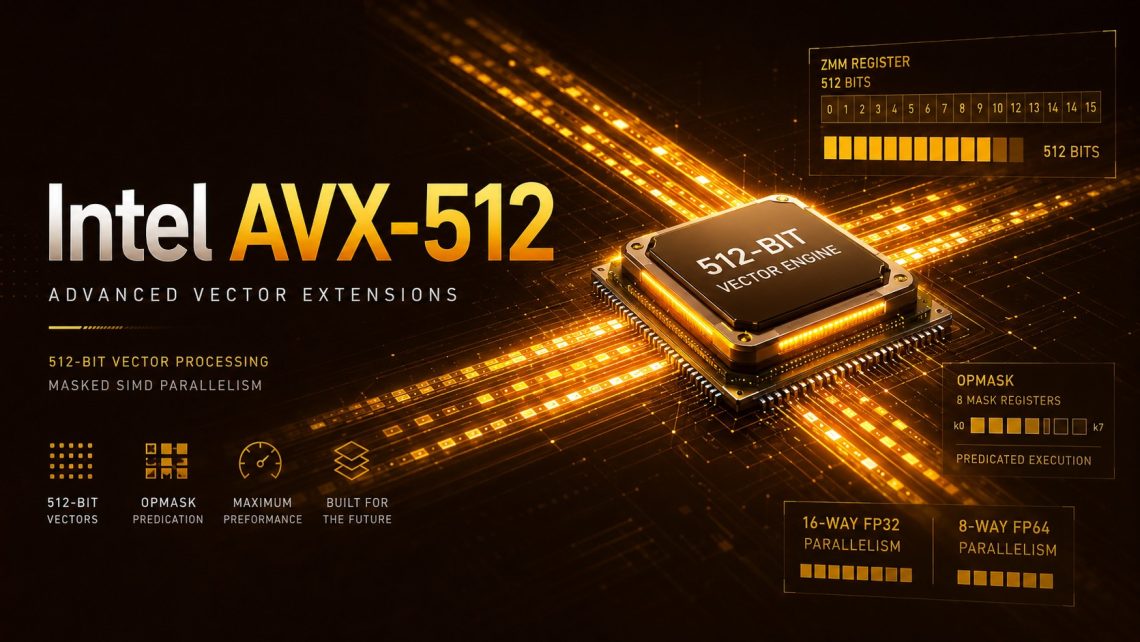
Intel AVX-512 is one of the most powerful and complex SIMD instruction set families in the x86 ecosystem. It extends the AVX and AVX2 model from 256-bit YMM registers to 512-bit ZMM registers, adds mask registers for per-element predication, introduces many new instructions, and expands the vector programming model far beyond a simple increase in register width.
AVX-512 is not just “AVX2 with bigger registers”. The real architectural shift is broader:
- More architectural vector registers in 64-bit mode.
- Dedicated mask registers.
- Per-element predication for many instructions.
- Richer instruction forms through EVEX encoding.
- New instructions for conflict detection, compression, expansion, byte and word operations, neural-network primitives, and other specialized workloads.
- More flexible tail handling without scalar cleanup loops in many cases.
AVX-512 is especially relevant for scientific computing, cryptography, compression, media processing, artificial intelligence, machine learning kernels, financial analytics, database engines, and other workloads where large amounts of data can be processed in parallel.
At the same time, AVX-512 is not as universally available as AVX2, and its performance characteristics depend heavily on the processor generation, thermal limits, vector width used, and specific AVX-512 subsets supported by the CPU.
Why AVX-512 mattered
AVX and AVX2 established 256-bit SIMD as a practical programming model on x86 processors. AVX focused mainly on 256-bit floating-point SIMD. AVX2 extended the same register model to 256-bit integer SIMD. Together, they made wide vector programming useful for a large range of floating-point and integer workloads.
AVX-512 went further: it doubled the maximum vector width again, from 256 bits to 512 bits, but it also changed how vector code could be written. The addition of mask registers made it possible to express conditional operations more naturally. Instead of branching or blending manually, many AVX-512 instructions can execute only on selected elements of a vector. This matters because real-world SIMD code is often not perfectly uniform. Some elements need to be processed, others ignored. Some loops end with a partial vector. Some data-dependent operations need to avoid writing invalid lanes. Some algorithms need comparisons to produce compact masks that can drive later operations. AVX-512 made these patterns much more natural.
For some workloads, AVX-512 can be a major performance improvement. For others, AVX2 remains a better target because it is more widely supported and may avoid some frequency or power-related tradeoffs.
SIMD in one sentence
SIMD means “single instruction, multiple data”. One instruction performs the same operation on many values packed inside a vector register.
A scalar addition processes one pair of values:
c0 = a0 + b0
A 512-bit AVX-512 addition can process sixteen 32-bit floating-point values:
c0  = a0  + b0
c1  = a1  + b1
c2  = a2  + b2
c3  = a3  + b3
c4  = a4  + b4
c5  = a5  + b5
c6  = a6  + b6
c7  = a7  + b7
c8  = a8  + b8
c9  = a9  + b9
c10 = a10 + b10
c11 = a11 + b11
c12 = a12 + b12
c13 = a13 + b13
c14 = a14 + b14
c15 = a15 + b15
All of that can be represented by one vector instruction.
For 64-bit double-precision floating-point values, a 512-bit register holds eight elements. For 32-bit integers, it holds sixteen elements. For 8-bit values, it can hold sixty-four elements when the relevant AVX-512 byte and word extensions are available.
How AVX-512 compares with earlier SIMD instruction sets
| Instruction set | Register width | Main focus | Key contribution |
|---|---|---|---|
| MMX | 64-bit | Packed integers | Early SIMD for multimedia and integer data |
| SSE | 128-bit | Single-precision floating point | Introduced XMM registers and FP data |
| SSE2 | 128-bit | Double-precision floating point and integer SIMD | Supported double-precision FP data |
| SSE3 | 128-bit | Horizontal arithmetic and data movement | Added selected reduction-friendly operations |
| SSSE3 | 128-bit | Shuffles and byte manipulation | Added powerful byte-level rearrangement instructions |
| SSE4.1 | 128-bit | Blends, dot products, integer operations | Improved media and general-purpose SIMD |
| SSE4.2 | 128-bit | Text and string processing | Added CRC and string comparison instructions |
| AVX | 256-bit | Floating-point SIMD | Introduced YMM registers and VEX encoding |
| AVX2 | 256-bit | Integer SIMD, gather, richer permutes | Brought most integer SIMD operations to 256 bits |
| FMA | 128-bit and 256-bit | Fused multiply-add | Computes a * b + c with one rounding step |
| AVX-512 | 512-bit | Wide vectors, masks, specialized instructions | Added ZMM registers, opmask registers, and predicated SIMD |
The important point is that AVX-512 is both wider and more expressive.
AVX2 answers this question:
How can I process more integer and floating-point values per instruction?
AVX-512 also answers this question:
How can I express vector conditions, partial writes, tails, and masks more directly?
The AVX-512 register model
AVX-512 introduces 512-bit ZMM registers.
The lower parts of each ZMM register overlap with the older YMM and XMM registers:
ZMM0 = upper 256 bits + YMM0
YMM0 = upper 128 bits + XMM0
Conceptually:
ZMM0 = 512-bit register
YMM0 = lower 256 bits of ZMM0
XMM0 = lower 128 bits of ZMM0
In 64-bit mode, AVX-512 expands the architectural vector register file to thirty-two ZMM registers, from zmm0 to zmm31. This is a major improvement over the sixteen XMM/YMM registers normally available in x86-64 AVX and AVX2 code. More registers matter because high-performance SIMD code often needs multiple inputs, outputs, constants, masks, accumulators, and temporary values. If the compiler runs out of registers, it must spill values to memory, which can hurt performance.
A 512-bit ZMM register can hold:
| Data type | Elements per ZMM register |
|---|---|
| 8-bit integer | 64 |
| 16-bit integer | 32 |
| 32-bit integer | 16 |
| 64-bit integer | 8 |
| 32-bit float | 16 |
| 64-bit double | 8 |
The exact instructions available for each element size depend on the AVX-512 subsets supported by the processor.
Opmask registers
The most important new concept in AVX-512 is the opmask register. AVX-512 provides eight mask registers, k0 through k7. Most predicated instructions use k1–k7 to control which vector elements, or lanes, are active; k0 generally means the instruction is unmasked.
For a vector of sixteen 32-bit elements, each mask bit controls one lane. Bit 0 controls element 0, bit 1 controls element 1, and so on:
Elements:  [0] [1] [2] [3] [4] [5] [6] [7] [8] [9] [10] [11] [12] [13] [14] [15]
Mask bits:  0   0   0   0   1   1   1   1   0   0    0    0    1    1    1    1
A set bit enables its lane; a clear bit disables it. In the diagram, the leftmost bit is bit 15 and the rightmost bit is bit 0.
Example: handling the end of an array
Suppose a loop processes sixteen integers at a time, but only eleven elements remain. Set the lowest eleven mask bits:
mask = 0000 0111 1111 1111 // 0x07FFThis enables lanes 0 through 10 and disables lanes 11 through 15. In C intrinsics, the mask can be formed as:
__mmask16 mask = (__mmask16)((1u << 11) - 1);Then use a masked load and store:
__m512i values = _mm512_maskz_loadu_epi32(mask, ptr);
__m512i result = /* compute using values */;
_mm512_mask_storeu_epi32(ptr, mask, result);
The masked load reads only the eleven active elements and sets the other lanes to zero. The masked store writes back only those eleven elements, so it does not access memory beyond the array’s end. This handles the tail without a separate scalar cleanup loop.
AVX-512 masks can also be used to:
- Add or otherwise compute only selected elements
- Store only selected elements
- Load only selected elements
- Compare only valid elements at the end of an array
They are useful for tail handling, conditional vector operations, filters, sparse or irregular data, parsing, and validation.
Merging and zeroing masks
AVX-512 mask operations support two behaviors: merge masking and zero masking. With merge masking, inactive elements keep their old destination value. With zero masking, inactive elements are set to zero.
For example, suppose we add two vectors using a mask:
result = a + b, but only where the mask is activeWith merge behavior, inactive lanes keep their previous result value. With zero behavior, inactive lanes become zero.
In Intel intrinsic names, zero-masked versions contain maskz. For example:
_mm512_mask_add_ps     // merge-masked add
_mm512_maskz_add_ps    // zero-masked add
EVEX encoding
AVX and AVX2 use VEX encoding. AVX-512 introduced EVEX encoding, which extends the instruction format to support features such as:
- 512-bit vectors
- More vector registers
- Opmask registers
- Zeroing and merging behavior
- Embedded broadcast
- Rounding controls in selected instructions
- Suppress-all-exceptions behavior in selected instructions
- Compressed memory displacements
This makes AVX-512 more than a wider version of AVX2: EVEX lets instructions use a richer set of controls.
An AVX2 integer-add instruction might look like this:
vpaddd ymm0, ymm1, ymm2It adds eight pairs of 32-bit integers. An AVX-512 version can add sixteen pairs and use a mask to select which results are active:
vpaddd zmm0 {k1}{z}, zmm1, zmm2Each bit in k1 controls one of the sixteen 32-bit lanes. For example, if only eleven elements remain at the end of an array, set the lowest eleven mask bits:
k1 = 0000 0111 1111 1111 // 0x07FFThe instruction adds lanes 0 through 10 and sets lanes 11 through 15 of zmm0 to zero because of {z}:
for each lane i from 0 to 15:
    if bit i of k1 is set:
        zmm0[i] = zmm1[i] + zmm2[i]
    else:
        zmm0[i] = 0
Without {z}, inactive lanes use merging behavior: their previous values in zmm0 are preserved. The mask controls which result lanes are updated; masked loads and stores can use a mask to limit which memory elements are accessed.
How older instruction sets handled this
AVX and AVX2 do not provide AVX-512’s general-purpose opmask control on arithmetic instructions. For a conditional vector result, code could calculate every lane and then use a blend instruction to select which results to keep. That takes extra instructions and does not make a masked-off memory access safe.
For a short array tail, a common approach was to process full vectors in a vector loop, then handle the remaining elements with a scalar loop. AVX2 also has specific masked load and store instructions for some data types, but they are limited memory operations; they do not provide the same general per-lane control across arithmetic, comparisons, and other instructions that AVX-512 masks do.
AVX-512 is a family, not one instruction set
Another major source of confusion is that AVX-512 is not a single monolithic instruction set. It is a family of extensions: the foundation subset is AVX-512F, and additional subsets add more capabilities. Common AVX-512 subsets include:
| Extension | Meaning | What it adds |
|---|---|---|
| AVX-512F | Foundation | Core 512-bit floating-point and integer operations for 32-bit and 64-bit elements |
| AVX-512CD | Conflict detection | Instructions useful for detecting conflicts in vectorized loops |
| AVX-512BW | Byte and word | Operations on 8-bit and 16-bit integer elements |
| AVX-512DQ | Doubleword and quadword | Additional 32-bit and 64-bit integer and floating-point operations |
| AVX-512VL | Vector length | AVX-512 features on 128-bit and 256-bit registers |
| AVX-512IFMA | Integer fused multiply-add | Useful for large integer arithmetic and cryptography |
| AVX-512VBMI | Vector byte manipulation | More powerful byte-level rearrangement |
| AVX-512VNNI | Vector neural network instructions | Dot-product style operations useful for inference |
| AVX-512BF16 | Brain floating point 16-bit | BF16 operations for AI workloads |
| AVX-512FP16 | Half-precision floating point | FP16 operations on supporting processors |
This modular structure is powerful but complicated. Two processors may both support “AVX-512” but support different AVX-512 subsets. Code must check for the exact features it uses.
A robust AVX-512 program should not check only if the CPU support AVX-512, but if it supports the specific AVX-512 subsets used in the code.
For example, byte-heavy code may require AVX-512BW. Neural-network inference code may require AVX-512VNNI. Code that uses AVX-512 masking with 256-bit vectors may require AVX-512VL.
AVX-512F
AVX-512F is the foundation of the AVX-512 family.
It provides the core 512-bit vector model, including:
- ZMM registers
- Opmask registers
- 512-bit floating-point operations
- 512-bit integer operations for 32-bit and 64-bit elements
- Basic arithmetic
- Comparisons
- Conversions
- Loads and stores
- Permutes
- Gather and scatter support for supported element sizes
AVX-512F alone does not provide everything people often expect from AVX-512. In particular, byte and 16-bit integer operations depend on AVX-512BW. This is important for image processing, text processing, compression, and many media workloads.
AVX-512BW
AVX-512BW adds byte and word operations. Many practical SIMD workloads are byte-heavy or 16-bit-heavy. Examples include:
- Image processing
- Video codecs
- Text scanning
- Compression
- Audio sample conversion
- Pixel masks
- Byte classification
- UTF-8 and UTF-16 processing
- Packed 16-bit arithmetic
With AVX-512BW, a 512-bit register can hold 64 bytes or 32 16-bit integers. This enables very wide packed operations over small integer types.
AVX-512VL
AVX-512VL is one of the most practically useful AVX-512 subsets: it allows many AVX-512 instructions to operate on 128-bit XMM and 256-bit YMM registers, not only 512-bit ZMM registers.
The reasons for using small registers are many: sometimes 256-bit vectors are faster or more power-efficient on a particular processor, or the data size is small, or the algorithm benefits more from masks than from wider vectors.
With AVX-512VL, code can use AVX-512 features such as opmask registers while still operating on 128-bit or 256-bit vectors.
AVX-512VNNI
AVX-512VNNI adds vector neural network instructions. The most important idea is efficient integer dot-product style computation, especially for inference workloads that use quantized data. This is useful for:
- Deep learning inference
- Matrix multiplication kernels
- Convolution kernels
- Quantized neural networks
- INT8 arithmetic
- High-throughput dot products
VNNI reduces the number of instructions needed for common multiply-and-accumulate patterns over packed integer data. In machine learning runtimes, this is important because quantized inference often spends much of its time in dot products and matrix multiplication.
AVX-512BF16 and AVX-512FP16
Later AVX-512 extensions added support for lower-precision floating-point formats. AVX-512BF16 supports bfloat16 operations, a format widely used in machine learning because it preserves a large exponent range while reducing memory bandwidth and storage compared with FP32. AVX-512FP16 supports IEEE half-precision floating-point operations on processors that implement it.
These extensions are especially relevant for:
- AI training support routines
- AI inference
- Matrix operations
- Signal processing
- Scientific workloads that tolerate lower precision
- Bandwidth-sensitive numerical code
Example: adding floating-point arrays with AVX-512
The following example adds two arrays of single-precision floating-point values using AVX-512 intrinsics.
#include <immintrin.h>
#include <stddef.h>

void add_float_avx512(const float *a, const float *b, float *out, size_t count)
{
    size_t i = 0;

    for (; i + 16 <= count; i += 16)
    {
        __m512 va = _mm512_loadu_ps(a + i);
        __m512 vb = _mm512_loadu_ps(b + i);
        __m512 vc = _mm512_add_ps(va, vb);

        _mm512_storeu_ps(out + i, vc);
    }

    for (; i < count; ++i)
    {
        out[i] = a[i] + b[i];
    }
}
The main loop processes sixteen float values per iteration.
Compared with AVX:
- AVX processes 8 floats per 256-bit vector
- AVX-512 processes 16 floats per 512-bit vector
Compared with SSE:
- SSE processes 4 floats per 128-bit vector
- AVX-512 processes 16 floats per 512-bit vector
This does not guarantee a 4x speedup over SSE or a 2x speedup over AVX. Memory bandwidth, instruction throughput, CPU frequency, cache locality, and thermal behavior all matter.
Example: tail handling with masks
One of the nicest features of AVX-512 is masked tail handling.
Without masks, vector code often needs a scalar cleanup loop for the final elements when the array length is not a multiple of the vector width.
With AVX-512, the final partial vector can often be handled with a mask.
#include <immintrin.h>
#include <stddef.h>
#include <stdint.h>

void add_float_avx512_masked(const float *a, const float *b, float *out, size_t count)
{
    size_t i = 0;

    for (; i + 16 <= count; i += 16)
    {
        __m512 va = _mm512_loadu_ps(a + i);
        __m512 vb = _mm512_loadu_ps(b + i);
        __m512 vc = _mm512_add_ps(va, vb);

        _mm512_storeu_ps(out + i, vc);
    }

    size_t remaining = count - i;

    if (remaining > 0)
    {
        __mmask16 mask = (__mmask16)((1u << remaining) - 1u);

        __m512 va = _mm512_maskz_loadu_ps(mask, a + i);
        __m512 vb = _mm512_maskz_loadu_ps(mask, b + i);
        __m512 vc = _mm512_add_ps(va, vb);

        _mm512_mask_storeu_ps(out + i, mask, vc);
    }
}
The mask selects only the valid elements in the final partial vector. This avoids reading or writing beyond the end of the arrays and avoids a scalar cleanup loop.
Example: comparing integers and using a mask
AVX2 comparisons typically produce a vector where each lane is all zeros or all ones. AVX-512 comparisons can produce mask registers directly.
For example:
#include <immintrin.h>
#include <stdint.h>

__mmask16 compare_int32_equal_avx512(const int32_t *a, int32_t value)
{
    __m512i v = _mm512_loadu_si512((const void *)a);
    __m512i target = _mm512_set1_epi32(value);

    return _mm512_cmpeq_epi32_mask(v, target);
}
The result is a 16-bit mask. If bit n is set, then:
a[n] == value
This is useful for:
- Search
- Filtering
- Database predicates
- Vectorized parsing
- Masked stores
- Conditional processing
- Compacting selected elements
AVX-512 makes masks a first-class part of the SIMD programming model.
Example: masked store
Suppose we want to write only the elements that satisfy a condition.
With AVX-512, this can be expressed directly:
#include <immintrin.h>
#include <stdint.h>

void store_selected_int32_avx512(int32_t *out, const int32_t *in, __mmask16 mask)
{
    __m512i v = _mm512_loadu_si512((const void *)in);

    _mm512_mask_storeu_epi32(out, mask, v);
}
Only the lanes selected by mask are stored.
This is much cleaner than manually blending values or branching per element.
Compress and expand operations
Some AVX-512 subsets include compress and expand operations.
These are useful for filtering and compaction.
For example, imagine a vector of sixteen integers and a mask selecting five of them:
values: [a b c d e f g h i j k l m n o p]
mask:   [1 0 0 1 0 1 0 0 0 1 0 0 1 0 0 0]
A compress operation can pack the selected values together:
[a d f j m]This is valuable for:
- Database filtering
- Stream compaction
- Removing invalid elements
- Sparse processing
- Vectorized parsers
- Geometry processing
- Data analytics
AVX2 can emulate some of these patterns, but AVX-512 provides much more direct support.
Gather and scatter
AVX2 introduced gather loads. AVX-512 improves the gather/scatter story and adds masked forms.
A gather reads from multiple addresses:
out[n] = base[index[n]]A scatter writes to multiple addresses:
base[index[n]] = value[n]These operations are useful for irregular data access patterns.
Examples include:
- Sparse matrices
- Graph algorithms
- Indirect table lookups
- Particle systems
- Geometry processing
- Database execution engines
- Scientific computing
However, gather and scatter are not substitutes for good data layout. Contiguous loads and stores are still usually much faster. If the data can be reorganized to make access contiguous, that is often better than relying on gather or scatter.
A practical rule is: use gather and scatter when irregular access is unavoidable, but prefer contiguous memory when the layout is under your control.
Compile flags
For GCC or Clang, AVX-512 code is usually compiled with feature-specific flags.
For the foundation subset:
gcc -O3 -mavx512f source.c -o programFor a more common set of AVX-512 server-style features:
gcc -O3 -mavx512f -mavx512vl -mavx512bw -mavx512dq -mavx512cd source.c -o programFor Clang:
clang -O3 -mavx512f -mavx512vl -mavx512bw -mavx512dq -mavx512cd source.c -o programFor Microsoft Visual C++, use:
/arch:AVX512The usual header for AVX-512 intrinsics is:
#include <immintrin.h>Be careful with global compiler flags. If the whole binary is compiled for AVX-512, the compiler may generate AVX-512 instructions outside your explicit intrinsic code. That binary will not run on processors without the required AVX-512 support. For portable software, compile separate versions of performance-critical functions and use runtime dispatch.
Runtime detection
AVX-512 detection is more complex than AVX2 detection.
A robust check must verify:
- The CPU supports AVX.
- The CPU supports XSAVE.
- The operating system supports extended vector state.
- The required XCR0 state bits are enabled.
- The CPU supports AVX-512F.
- The CPU supports every additional AVX-512 subset used by the code.
For example, if the code uses byte and word operations, it may require AVX-512F and AVX-512BW. If it uses 128-bit or 256-bit EVEX-encoded forms with masks, it may require AVX-512F and AVX-512VL. If it uses neural-network dot-product instructions, it may require AVX-512VNNI.
Do not assume that all AVX-512 processors support all AVX-512 instructions. A typical runtime dispatch model looks like this:
if AVX-512F + AVX-512VL + AVX-512BW + AVX-512DQ are available:
    use AVX-512 implementation
else if AVX2 is available:
    use AVX2 implementation
else if SSE4.1 is available:
    use SSE4.1 implementation
else:
    use scalar implementation
The exact dispatch logic depends on what the code actually uses.
AVX-512 and memory bandwidth
A 512-bit vector can process twice as many bytes as a 256-bit AVX2 vector, but this does not mean every AVX-512 loop is twice as fast as AVX2. Many loops are limited by memory bandwidth.
Consider this operation:
out[i] = a[i] + b[i];For each element, the CPU must load two inputs and store one output. The arithmetic is simple, just an addition. The memory traffic may dominate.
AVX-512 helps most when:
- Data is in cache.
- The loop performs many operations per loaded byte.
- The memory access pattern is predictable.
- The algorithm has enough independent work.
- The code benefits from masks, wider registers, or extra registers.
- The CPU can sustain the wider vector execution efficiently.
AVX-512 helps less when:
- The workload is main-memory bandwidth-bound.
- The data access pattern is random.
- The loop is branch-heavy.
- The arrays are small.
- The CPU reduces frequency under heavy AVX-512 usage.
- The code spends too much time rearranging data.
The correct answer is always workload-specific, so run benchmarks on the target hardware.
AVX-512 and CPU frequency
AVX-512 instructions can consume significant power. On some processors, sustained AVX-512 execution can reduce CPU frequency compared with scalar, SSE, AVX, or AVX2 code. This means that performance must be measured carefully. A 512-bit instruction may do more work per instruction, but if the CPU lowers its clock speed, the net result depends on the workload.
AVX-512 is most attractive when the additional work per instruction more than compensates for any frequency or power cost.
This is especially likely in:
- Compute-heavy loops
- Dense numerical kernels
- Matrix operations
- Cryptography
- Video compression primitives
- AI inference kernels
- Algorithms that benefit strongly from masks or extra registers
It is less likely in:
- Memory-bound loops
- Light scalar-heavy code
- Short bursts where setup dominates
- Code with poor data locality
- Workloads with little arithmetic intensity
Again, benchmark the real application, not only a small synthetic loop.
Data layout matters even more
AVX-512 rewards good data layout and punishes poor data layout. A 512-bit load brings in 64 bytes at once, a full cache line on many systems. This is excellent when the data is contiguous, but less useful when the data is scattered, interleaved awkwardly, or only partially needed.
For example, this layout is convenient:
typedef struct Particle
{
    float x;
    float y;
    float z;
    float vx;
    float vy;
    float vz;
} Particle;

Particle particles[count];
But AVX-512 code may prefer separate arrays:
float x[count];
float y[count];
float z[count];
float vx[count];
float vy[count];
float vz[count];
This structure-of-arrays layout allows the CPU to load sixteen x values, sixteen y values, or sixteen velocity values with simple contiguous loads.
The best layout depends on the algorithm, but AVX-512 makes layout decisions even more important because each vector operation covers more data.
Alignment and unaligned loads
AVX-512 vector registers are 64 bytes wide. For a 512-bit load or store, the aligned intrinsics require the memory address to be 64-byte aligned. The unaligned versions accept any address, though accesses that cross cache-line boundaries can sometimes cost more.
For single-precision floating-point values:
_mm512_load_ps(ptr);       // Load 16 floats; ptr must be 64-byte aligned
_mm512_loadu_ps(ptr);      // Load 16 floats; ptr may be unaligned
_mm512_store_ps(ptr, v);   // Store 16 floats; ptr must be 64-byte aligned
_mm512_storeu_ps(ptr, v);  // Store 16 floats; ptr may be unaligned
For 512-bit integer vectors:
_mm512_load_si512(ptr);       // Load 64 bytes; ptr must be 64-byte aligned
_mm512_loadu_si512(ptr);      // Load 64 bytes; ptr may be unaligned
_mm512_store_si512(ptr, v);   // Store 64 bytes; ptr must be 64-byte aligned
_mm512_storeu_si512(ptr, v);  // Store 64 bytes; ptr may be unaligned
The aligned forms require a 64-byte-aligned pointer. Passing them a pointer that is not aligned can cause a fault. Use the unaligned forms when you cannot guarantee the alignment.
Allocating an aligned buffer in Visual C++
In Visual C++, use _aligned_malloc to allocate a buffer with a specified alignment, and _aligned_free to release it. This example allocates 32 floats, or two 512-bit vectors:
#include <immintrin.h>
#include <malloc.h>
#include <cstddef>

int main()
{
    constexpr std::size_t count = 32;
    constexpr std::size_t alignment = 64;

    float* input = static_cast<float*>(
        _aligned_malloc(count * sizeof(float), alignment));
    float* output = static_cast<float*>(
        _aligned_malloc(count * sizeof(float), alignment));

    if (input == nullptr || output == nullptr) {
        _aligned_free(input);
        _aligned_free(output);
        return 1;
    }

    // Initialize input before using it.

    for (std::size_t i = 0; i < count; i += 16) {
        __m512 values = _mm512_load_ps(input + i);
        _mm512_store_ps(output + i, values);
    }

    _aligned_free(input);
    _aligned_free(output);
    return 0;
}
Both buffers are 64-byte aligned, and each loop iteration advances by 16 floats (64 bytes), so every address passed to the aligned load and store intrinsics remains aligned.
Modern processors handle many unaligned accesses efficiently. Use aligned allocation when it fits the buffer’s layout, and use unaligned intrinsics when alignment is not guaranteed. Measure performance before adding extra alignment logic.
Every load and store must stay within valid memory. For a final partial vector, use an appropriate masked load or store, or handle the remaining elements separately. An ordinary full-width load can read past the end of the buffer.
Reductions with AVX-512
AVX-512 is excellent for vertical SIMD operations:
c[i] = a[i] + b[i]Reductions are still more complicated:
sum = a[0] + a[1] + a[2] + ...A reduction eventually needs to combine elements inside a vector.
A simple AVX-512 floating-point sum can look like this:
#include <immintrin.h>
#include <stddef.h>

float sum_float_avx512(const float *a, size_t count)
{
    size_t i = 0;
    __m512 acc = _mm512_setzero_ps();

    for (; i + 16 <= count; i += 16)
    {
        __m512 v = _mm512_loadu_ps(a + i);
        acc = _mm512_add_ps(acc, v);
    }

    float temp[16];
    _mm512_storeu_ps(temp, acc);

    float sum = 0.0f;

    for (int j = 0; j < 16; ++j)
    {
        sum += temp[j];
    }

    for (; i < count; ++i)
    {
        sum += a[i];
    }

    return sum;
}
This example is simple and clear, but not necessarily the fastest possible implementation. A more optimized version might use multiple accumulators, masked tails, horizontal reduction intrinsics, or processor-specific tuning.
The general rule remains the same: do most work vertically, and reduce horizontally only when needed.
AVX-512 and masked reductions
AVX-512 masks can make reductions cleaner when the final vector is partial. For example, a masked final load can avoid reading beyond the end of the array:
#include <immintrin.h>
#include <stddef.h>

float sum_float_avx512_masked_tail(const float *a, size_t count)
{
    size_t i = 0;
    __m512 acc = _mm512_setzero_ps();

    for (; i + 16 <= count; i += 16)
    {
        __m512 v = _mm512_loadu_ps(a + i);
        acc = _mm512_add_ps(acc, v);
    }

    size_t remaining = count - i;

    if (remaining > 0)
    {
        __mmask16 mask = (__mmask16)((1u << remaining) - 1u);
        __m512 tail = _mm512_maskz_loadu_ps(mask, a + i);

        acc = _mm512_add_ps(acc, tail);
    }

    float temp[16];
    _mm512_storeu_ps(temp, acc);

    float sum = 0.0f;

    for (int j = 0; j < 16; ++j)
    {
        sum += temp[j];
    }

    return sum;
}
This is one of the areas where AVX-512 feels much more elegant than AVX2. The vector loop can handle the tail safely without a scalar cleanup loop.
AVX-512 in scientific computing
Scientific computing is one of the natural homes of AVX-512.
Many scientific workloads involve dense floating-point computation over large arrays:
- Linear algebra
- Stencil computations
- Finite difference methods
- Molecular dynamics
- Physics simulation
- Weather modeling
- Signal processing
- N-body simulation
- Monte Carlo methods
AVX-512 can help when the workload has enough arithmetic intensity and the data layout is vector-friendly.
The extra registers are also useful. Scientific kernels often need multiple accumulators, constants, and temporary vectors. Having thirty-two ZMM registers in 64-bit mode can reduce register pressure significantly.
AVX-512 in AI and machine learning
AVX-512 is important in AI and machine learning, especially for CPU inference and optimized math libraries.
Relevant extensions include:
- AVX-512F for wide floating-point operations
- AVX-512VNNI for integer dot-product style operations
- AVX-512BF16 for bfloat16 support
- AVX-512FP16 for half-precision operations on supporting processors
These are useful for:
- Matrix multiplication
- Convolution
- Quantized inference
- Embedding operations
- Transformer support kernels
- Preprocessing and postprocessing
- Small-batch inference where CPU latency matters
For large-scale training, GPUs and accelerators are usually more important, but CPUs still matter for inference, data preparation, recommendation systems, and mixed workloads where moving data to another device would add overhead.
AVX-512 in cryptography and big integer arithmetic
Some AVX-512 subsets are useful for cryptography and large integer arithmetic. AVX-512IFMA, for example, supports integer fused multiply-add operations that can help with large-number arithmetic. This is relevant for workloads such as:
- Modular arithmetic
- Homomorphic encryption
- Public-key cryptography support routines
- Number-theoretic transforms
- Large integer multiplication
AVX-512 can also help with symmetric cryptography and hashing support routines when the algorithm has enough data-level parallelism.
AVX-512 in text processing
AVX-512 can be very powerful for text scanning, parsing, and validation. A 512-bit register can hold 64 bytes. With AVX-512BW, this allows a single vector operation to inspect 64 characters at once.
Useful patterns include:
- Finding delimiters
- Detecting whitespace
- Detecting quote characters
- Classifying ASCII ranges
- Validating UTF-8
- Transcoding between text formats
- Finding structural characters in JSON
- Scanning logs
- Parsing CSV-like data
The mask model is especially useful here. A comparison can produce a compact mask, and scalar bit operations can then locate matching byte positions quickly.
AVX-512 in databases and analytics
Database engines and analytics systems can benefit from AVX-512 because many operations are column-oriented and data-parallel.
Examples include:
- Filtering integer columns
- Comparing values against predicates
- Scanning null masks
- Evaluating selection vectors
- Compacting matching rows
- Processing bitsets
- Accelerating hash table support operations
- Vectorized execution over batches of rows
Masks, compress operations, and wide comparisons are especially useful.
For example, a database engine can compare sixteen 32-bit values against a threshold and produce a mask of matching rows. That mask can then drive a compressed store, a count, or a selection vector update. This is a more natural fit for AVX-512 than for earlier SIMD instruction sets.
AVX-512 versus AVX2
AVX-512 has several advantages over AVX2:
| Feature | AVX2 | AVX-512 |
|---|---|---|
| Maximum vector width | 256 bits | 512 bits |
| 32-bit floats per vector | 8 | 16 |
| 64-bit doubles per vector | 4 | 8 |
| 32-bit integers per vector | 8 | 16 |
| Dedicated mask registers | No | Yes |
| Masked loads and stores | Limited patterns | First-class feature |
| More vector registers | 16 in x86-64 | 32 in x86-64 |
| Compress and expand support | No direct equivalent | Available in AVX-512 subsets |
| Feature fragmentation | Lower | Higher |
| Broad consumer compatibility | Higher | Lower |
AVX2 is often the best compatibility target. AVX-512 is often the best performance target for selected workloads on processors that support it.
The decision should be based on:
- Target CPUs
- Workload type
- Data layout
- Memory bandwidth
- Thermal behavior
- Required AVX-512 subsets
- Maintenance cost
- Existing library support
For many applications, the ideal approach is runtime dispatch:
- Use AVX-512 where it is available and useful.
- Use AVX2 as the widely supported high-performance fallback.
- Use scalar or SSE paths for older systems.
AVX-512 versus AVX10
AVX10 is a newer attempt to provide a more consistent future AVX programming model across processors. It is related to the AVX-512 lineage but should not be treated as a simple replacement in existing software.
The practical advice is:
- Use AVX-512 when targeting CPUs that support the needed subsets.
- Use runtime dispatch for portable software.
- Watch compiler and processor documentation as AVX10 support matures.
- Avoid assuming that future AVX-family support will map exactly to today’s AVX-512 subsets.
Common pitfalls
Thinking AVX-512 is one feature
AVX-512 is a family of extensions. Check the exact subset required by your code.
Assuming wider is always faster
A 512-bit vector processes more data per instruction, but performance depends on memory bandwidth, instruction throughput, frequency behavior, and the workload.
Ignoring CPU frequency effects
Heavy AVX-512 code can affect CPU frequency on some processors. Always benchmark realistic workloads.
Forgetting about masks
Masks are one of the biggest advantages of AVX-512. Code that only treats AVX-512 as wider AVX2 may miss much of its value.
Using AVX-512BW instructions without checking AVX-512BW
Byte and 16-bit operations require the relevant subset. AVX-512F alone is not enough.
Assuming all AVX-512 processors support VNNI, BF16, or FP16
These are separate extensions. Detect them separately.
Overusing gather and scatter
Gather and scatter are useful for irregular access, but contiguous memory access is usually better.
Compiling the whole binary with AVX-512
If the whole application is compiled with AVX-512, it may fail on CPUs that do not support the required instructions. Use dispatch when compatibility matters.
Writing intrinsics too early
AVX-512 intrinsics are powerful but complex. Use them where profiling shows a clear bottleneck.
Practical optimization checklist
When optimizing with AVX-512, use this checklist:
- Profile the application first.
- Identify the actual hot loops.
- Check whether AVX2 is already good enough.
- Confirm that target CPUs support the required AVX-512 subsets.
- Use runtime dispatch for portable software.
- Make data contiguous whenever possible.
- Use masks for tails and conditional lanes.
- Avoid unnecessary gather and scatter.
- Prefer structure-of-arrays layouts for heavily vectorized code.
- Watch for memory bandwidth limits.
- Watch for frequency and thermal behavior.
- Benchmark on the real target hardware.
- Compare against AVX2, not only scalar code.
- Keep scalar or AVX2 fallbacks.
- Use optimized libraries when available.
When to use AVX-512 intrinsics
AVX-512 intrinsics are useful when:
- The loop is performance-critical.
- The target CPUs support the required AVX-512 features.
- The workload is dense and data-parallel.
- The code benefits from masks or wider vectors.
- The compiler cannot auto-vectorize well enough.
- You need explicit control over layout, masks, or instruction selection.
- You can maintain fallback implementations.
They are especially useful for:
- Scientific kernels
- Matrix operations
- AI inference primitives
- Cryptography
- Compression
- Database filtering
- Text scanning
- Wide integer processing
- Image and video processing
- Sparse or irregular algorithms that benefit from masks
They are less useful when:
- The code is not hot.
- The data sets are small.
- The workload is memory-bound.
- The code is branch-heavy.
- The target CPUs do not reliably support AVX-512.
- Maintainability matters more than maximum speed.
- Existing libraries already provide optimized implementations.
Auto-vectorization versus intrinsics
Modern compilers can generate AVX-512 code automatically when the target architecture enables it.
Simple loops such as:
for (size_t i = 0; i < count; ++i)
{
    out[i] = a[i] + b[i];
}
may be auto-vectorized by the compiler.
However, AVX-512 intrinsics can be useful when the compiler struggles with:
- Complex masks
- Manual tail handling
- Data compaction
- Gather and scatter patterns
- Lookup-like operations
- Non-trivial shuffles
- Reductions
- Mixed integer and floating-point operations
- Specialized instructions such as VNNI or BF16
A good workflow is:
- Write clear scalar code.
- Enable compiler optimization.
- Check vectorization reports or generated assembly.
- Profile.
- Use AVX-512 intrinsics only for the bottlenecks that need them.
AVX-512 in modern software
AVX-512 is used in many performance-sensitive software stacks, especially on servers and workstations. It commonly appears in:
- BLAS libraries
- Deep learning runtimes
- Image processing libraries
- Video codecs
- Compression libraries
- Cryptographic libraries
- Database engines
- Search engines
- Scientific computing frameworks
- Financial analytics engines
- HPC applications
Many applications benefit from AVX-512 indirectly through optimized libraries. This is often preferable to writing custom AVX-512 code. For example, a math library may dispatch internally to:
scalar implementation
SSE2 implementation
AVX implementation
AVX2 + FMA implementation
AVX-512 implementation
The application gets the benefit without maintaining low-level SIMD code itself.
AVX-512 and portability
AVX-512 support is more fragmented than AVX2 support, so software should not assume AVX-512 is available. A practical implementation strategy is:
generic scalar implementation
SSE2 implementation
SSE4.1 or SSSE3 implementation
AVX2 implementation
AVX2 + FMA implementation
AVX-512 implementation
At runtime, the program selects the best supported path. This gives strong performance on modern CPUs while preserving compatibility with older systems.
Conclusion
Intel AVX-512 is one of the most significant SIMD extensions ever added to x86 processors. It extends the AVX model to 512-bit ZMM registers, doubles the maximum vector width compared with AVX2, adds more architectural registers, and introduces mask registers as a first-class part of SIMD programming.
Its biggest contribution is not only width. The real power of AVX-512 comes from the combination of:
- wide vectors
- more registers
- per-element masks
- richer instruction forms
- specialized extensions
This makes AVX-512 especially useful for scientific computing, AI inference, cryptography, compression, database engines, media processing, text scanning, and other workloads that can exploit dense data parallelism.
But AVX-512 also requires care. It is more fragmented than AVX2, not universally available, and can have different power and frequency behavior depending on the processor. The best AVX-512 code is written with feature detection, runtime dispatch, good data layout, realistic benchmarking, and fallback paths.
For developers, AVX-512 is not always the default target. AVX2 remains the safer high-performance baseline for broad compatibility. But when the target hardware supports the right AVX-512 subsets and the workload maps well to wide vectors and masks, AVX-512 can be one of the most powerful tools available for CPU-side performance optimization.
References
- Intel® Advanced Vector Extensions 512 overview
- Intel® AVX-512 instructions
- Intel® 64 and IA-32 Architectures Software Developer’s Manuals
- Intel® Intrinsics Guide
- Intel® Architecture Instruction Set Extensions Programming Reference
- GCC x86 options
- Microsoft Learn: /arch x64 compiler option
- Agner Fog optimization manuals and instruction tables
- Transcoding Unicode characters with AVX-512 instructions, Robert Clausecker and Daniel Lemire
- Intel HEXL: Accelerating homomorphic encryption with Intel AVX512-IFMA52