• SIMD

    SSE2 preview

    The forthcoming Intel Pentium 4 processor (code-named Willamette)  will feature a new set of SIMD instructions that improve the capabilities of both the MMX and SSE instruction sets. The key benefits of SSE2 are that MMX instructions can work on 128-bit data blocks, and that SSE instructions now support 64-bit…

  • SIMD

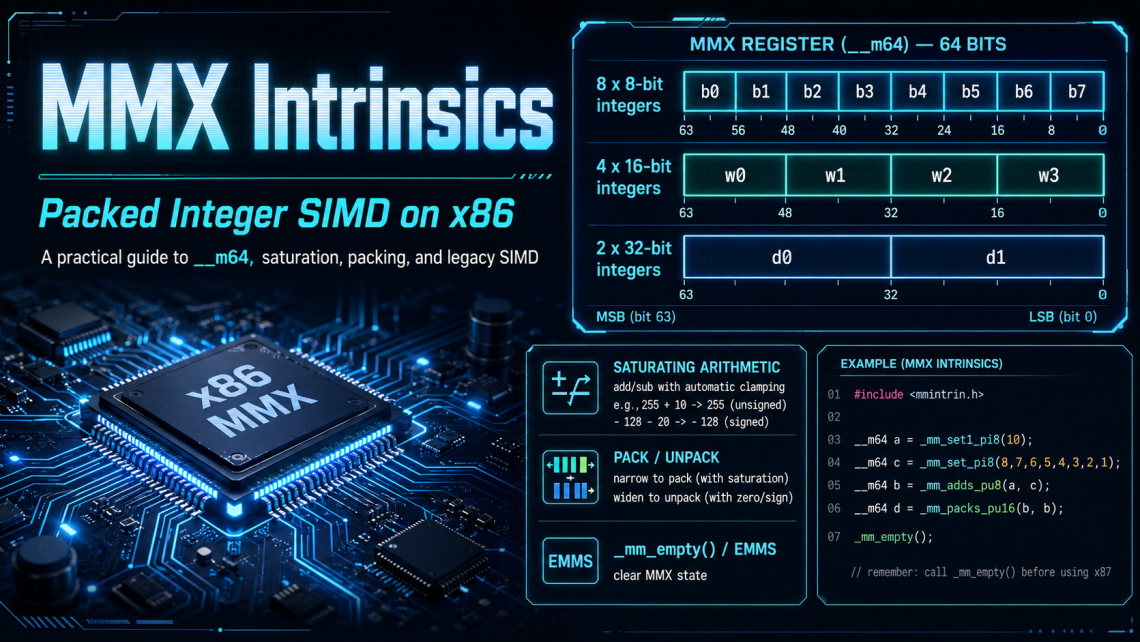
    MMX Performance on Intel Pentium 4

    The recent arrival of the Intel Pentium 4 processor has generated the usual flurry of benchmarks and comments, most of them emphasizing that current software does not fully exploit the power of this new architecture (click here for an overview of the SSE2 instruction set). However, until the Pentium 4…

  • SIMD

    MMX / iSSE latency

    The following table summarizes the latencies of MMX/iSSE instructions on the Intel Pentium III and Pentium 4 processors, and on the AMD Athlon processor:     Instruction Pentium III Pentium 4 AMD Athlon MOVD mm,r32 1 2 3 MOVD r32,mm 1 5 5 MOVQ mm,mm 1 6 2 PACKSSWB /…

  • SIMD

    Map of Instruction sets / CPU

    The following table lists the Instruction Sets supported by each processor.   Processor MMX Extended MMX SSE SSE2 3DNow! Intel Pentium           Intel Pentium MMX         Intel Pentium II         Intel Celeron         Intel Pentium III  …

  • SIMD

    Intel Pentium III

    The Intel P6 core, introduced with the Pentium Pro processor and used in all current Intel processors, features a RISC-like microarchitecture and an out-of-order execution unit, representing a radical shift from previous designs.  The P6’s new dynamic execution micro-architecture removes the constraint of linear instruction sequencing between the traditional fetch…

  • SIMD

    Detecting MMX and SSE

    The MMX instructions are supported by every x86 processor introduced in the market after the venerable Intel Pentium MMX, so it should be fairly safe to assume that the processor that your code is running on has MMX instructions. But checking for MMX instructions is really simple and it avoids…

  • SIMD

    3DNow!

    The latest trend in PC games is 3D graphics: during the past few years, almost all kinds of games have turned to 3D graphics, greatly increasing the demand of processors with strong floating-point performance, because the front end of a typical 3D game software pipeline must perform object physics, geometry…

  • SIMD

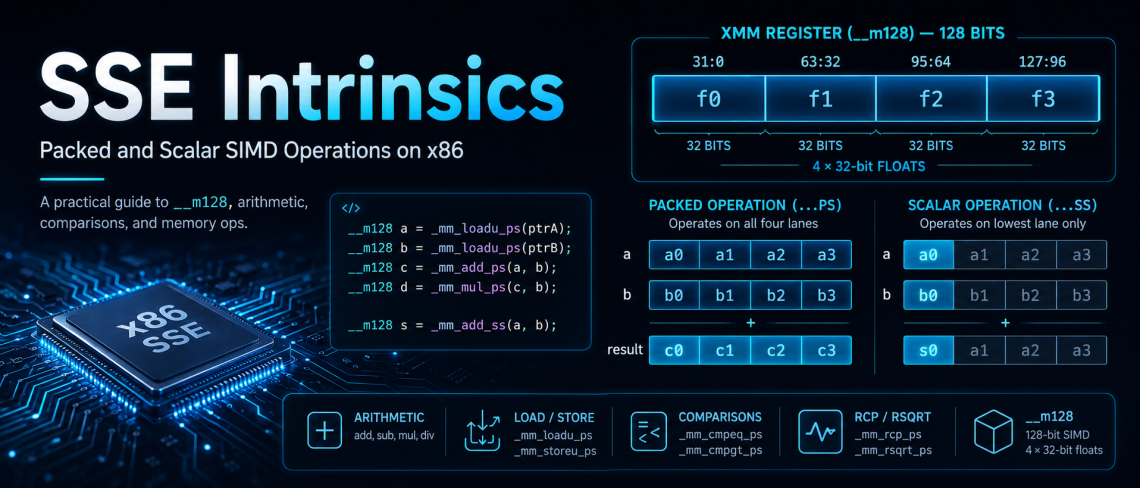
    SSE Introduction

    The Streaming SIMD Extensions enhance the Intel x86 architecture in four ways: 8 new 128-bit SIMD floating-point registers that can be directly addressed; 50 new instructions that work on packed floating-point data; 8 new instructions designed to control cacheability of all MMX and 32-bit x86 data types, including the ability…